Key points
- Prevent damage before attempting to make an object look clean.
- Do not apply one cleaning recipe to every amulet.
- Record condition and keep detached fragments without gluing them yourself.
Start Somdej amulet care by recognising uncertainty
Somdej amulet care begins by avoiding the assumption that every piece has the same composition or condition. Objects described as powder-based amulets may have fragile surfaces, old repairs or additional materials unknown to the keeper. This article offers damage-prevention principles, not a cleaning or restoration recipe.
CCI guidance explains how suitable handling and storage reduce risks to fragile objects and notes that some porous materials can be sensitive to handling [1]. The editor applies a cautious approach without assuming that powder-based amulets behave exactly like fired ceramics or glass.
Reduce movement and provide stable support
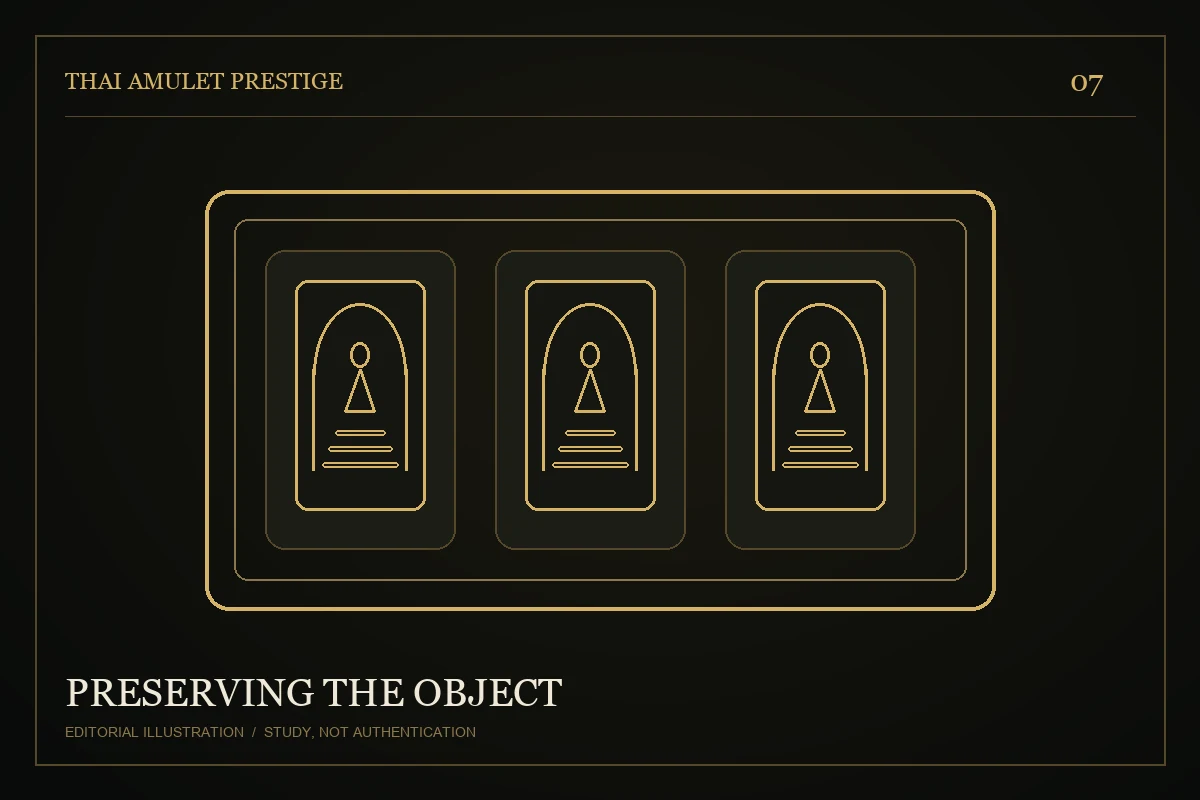
Use separate storage spaces to prevent objects from striking one another. Choose clean, non-abrasive trays or supports that do not squeeze raised details. Where possible, move the support with the object rather than repeatedly placing the amulet on different surfaces.
CCI stresses supporting weight and selecting handling methods for the object’s condition [2]. Gloves are not the only answer in every situation: they must fit and must not reduce grip. If handling is uncertain, particularly with cracks or loose powder, seek help first.
Do not begin with washing, coating or polishing
Do not use water, oil, cleaning agents, stiff brushes or glue on an object of unknown composition merely to make it look newer. Such actions can alter a surface and destroy information about its earlier condition. A visible deposit does not automatically need removal.
If dirt appears concerning, photograph it and note when it was found before intervening. A conservator should be able to see the original condition and handling history. Previous oiling or repairs can affect the choice of treatment.
Consider the environment together with the materials
Select a location away from falls, impacts, strong sunlight, water and heat sources. Avoid unnecessary abrupt environmental changes. Do not place unidentified desiccants or wrapping materials directly against the object.
This article gives no single humidity figure guaranteed to suit every amulet. Mixed materials, repairs and existing surface problems call for assessment of the individual object rather than directly adopting storage settings for another material.
Keep a simple, comparable condition record
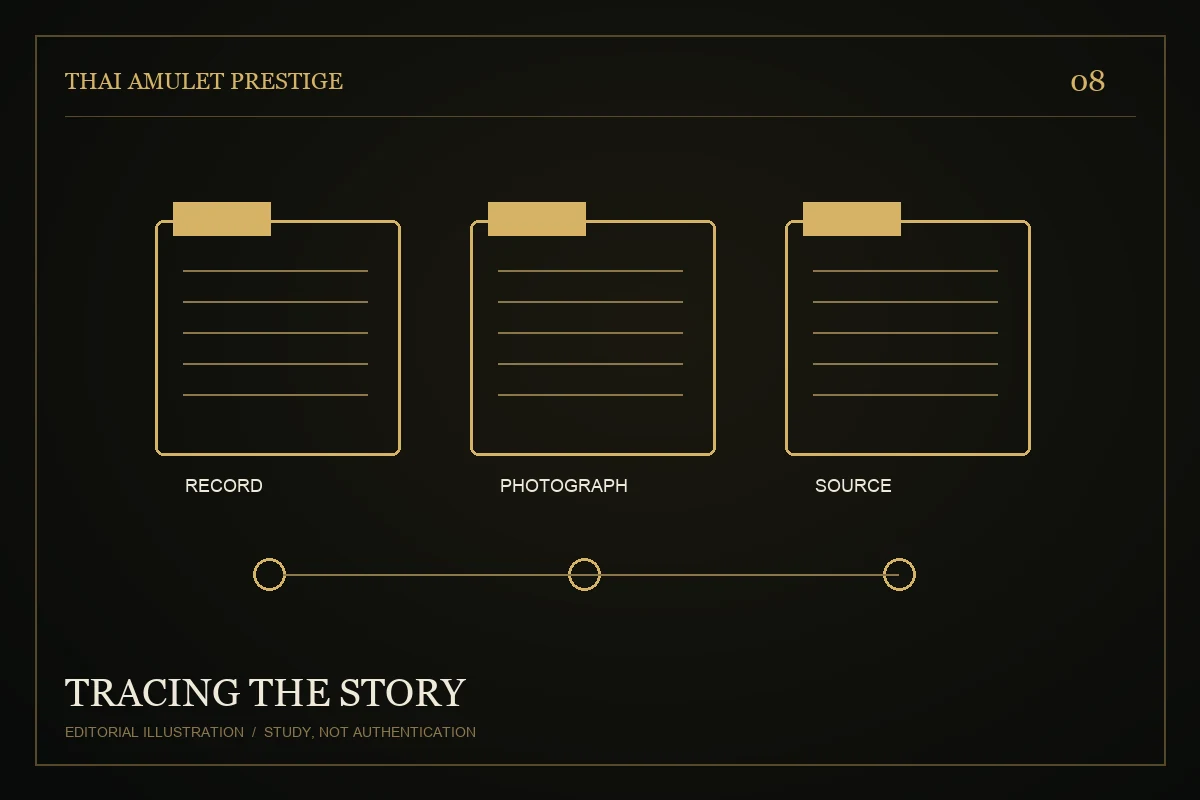
Use an object ID and date. Photograph the same angles under similar light and describe changes without guessing their causes. Keeping an object’s documentation associated with it is one concern addressed in CCI’s archaeological collections guidance [3].
- Locate cracks or loose powder using an overall photograph.
- Record changes of box, frame or support material.
- Keep detached fragments safely separated, identified by the object ID and where they were found.
- Do not test a questionable area by pressing, scratching or bending it.
When to stop handling it yourself
If cracks widen, parts move, a surface continues to flake or an attached substance is unidentified, stop unnecessary contact and consult someone with conservation knowledge. Preserving the remaining condition and information is often more important than making an object look complete quickly.
Sources & further reading
- Care of Ceramics and Glass — CCI Notes 5/1Fragility of porous materials and the importance of handling and storage. Powder-based amulets are not equated with fired ceramics.
- Handling heritage objects — Canadian Conservation InstituteSupporting an object from beneath and assessing glove suitability; not prescribing one glove type for every material.
- Caring for archaeological collections — Canadian Conservation InstitutePreventing impact and retaining the association between objects and their documentation.
Translated and adapted from the Thai article compiled by Thai Amulet Prestige, using the listed sources and the editor’s study suggestions. This is not an authentication report for an individual amulet. The Thai source edition records its source check as 3 November 2026. Illustrations do not establish an amulet’s age, maker or authenticity.