Key points
- Begin by checking what the document addresses and who issued it.
- Photographs, numbers and distinctive features must connect to the actual object.
- Awards, materials reports and authentication opinions are different evidence types.
Begin with the scope of Somdej amulet certificates
Somdej amulet certificates vary in format and scope. Some documents identify an object, some report materials testing and others give classification opinions. Read the headings, examination method and limitations before interpreting them.
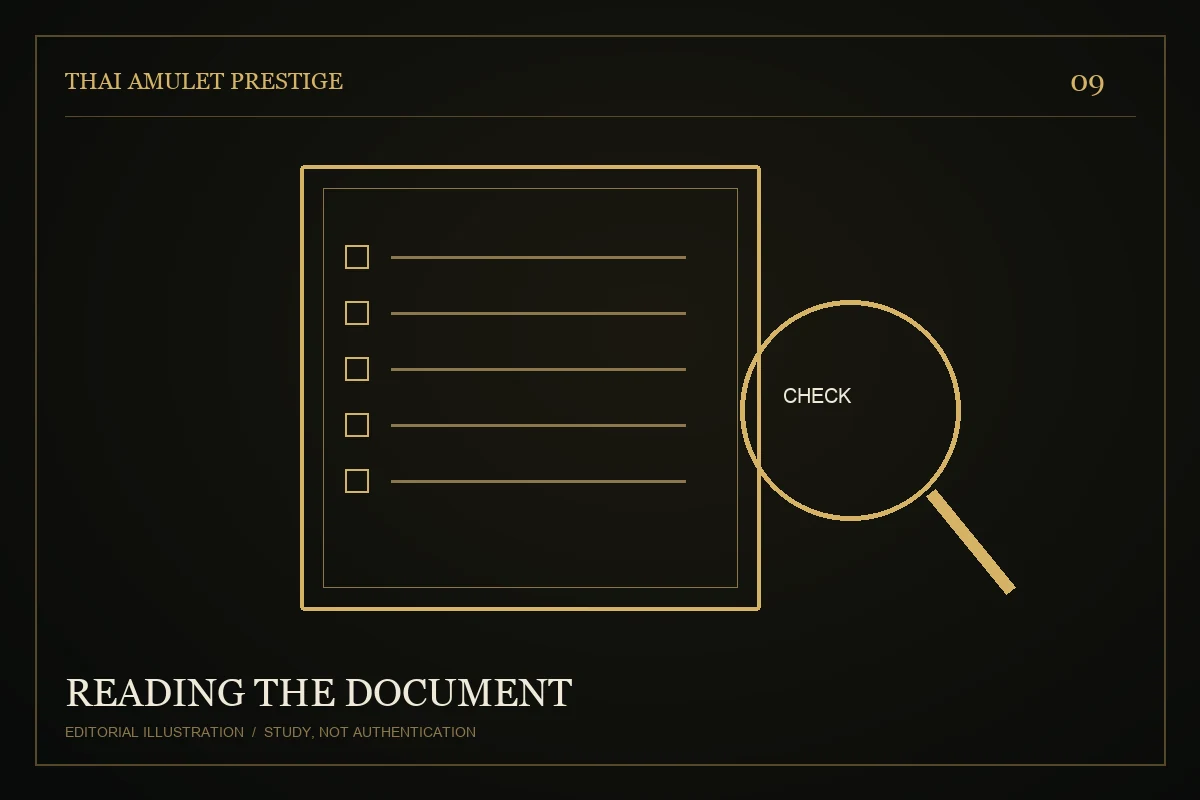
This is the editor’s document-reading checklist. It does not announce standards for an association, company or examiner, and does not endorse documents displayed on this website.
Check the issuer through an independent channel
Start with the organisation or opinion-giver, issue date and reference number. To verify a document, find the issuer’s official contact independently rather than relying only on a telephone number or link printed in a received image.
If there is a QR code, inspect its destination before opening it and check that the page shows information about that particular document. A successful scan or working page is only one step. It does not establish that the database entry corresponds to the object now presented.
Compare the document with the object, not just the type name
ICOM and INTERPOL object-identification guidance emphasises photographs, dimensions, marks and distinctive features [1][2]. Use this approach to ask how a document shows the same object. Many pieces share a type name, so the name alone is insufficient.
A very dark or small front image may offer limited detail for comparison. If the object was framed or its condition changed after issue, additional records are needed. Do not explain hidden areas by guessing.
Distinguish certificates, materials reports and awards
A materials analysis answers questions within the method used. An award document concerns a result under the rules and conditions of a particular event. Substituting one type of evidence for another requires an explanation and must not extend beyond the original wording.
For an award history, check the event, organiser, date, category and evidence connecting the result to the relevant object. A photograph of a trophy or an attractive frame is not proof of a competition result. Display order on a website is not an award ranking.
Check before publishing a document
Keep full copies securely and check permission to publish scans or photographs. This list helps readers understand the scope of the evidence actually available.
- Are the issuer, issue date and reference number legible?
- Is the stated maker or year a test finding, a hypothesis or information supplied by the submitter?
- How closely do photographs and distinctive features match the object today?
- Are there conditions, exclusions or additional pages that have not been supplied?
- Is personal information clearly redacted while retaining information needed for checking?
Should a certificate end the investigation?
No. A supporting document does not remove the need to read the evidence’s scope. Check which questions the opinion covers, when it was written and how it still connects to the object. Ask the issuer directly if necessary. This article does not declare any issuer’s document genuine or false.
Sources & further reading
- Object ID — International Council of MuseumsFields for identifying objects, photographs, descriptions and safe records; not an authenticity certification standard.
- Object ID — INTERPOLObject documentation and assistance with identification after loss; not an amulet authentication database.
- The CDWA and Other Metadata Standards — Getty Research InstituteStructured description systems and object-identification information.
Translated and adapted from the Thai article compiled by Thai Amulet Prestige, using the listed sources and the editor’s study suggestions. This is not an authentication report for an individual amulet. The Thai source edition records its source check as 3 November 2026. Illustrations do not establish an amulet’s age, maker or authenticity.