Key points
- Biographies can share core facts while differing in detail.
- Attributing an object to a maker requires evidence about that object.
- A library catalogue points to further reading; it does not mean the book has been read.
Somdet To and Wat Rakhang in the available accounts
Somdet To and Wat Rakhang appear together in biographies, devotional writing and community stories. The Museum for the Support of Buddhism describes Somdet Phra Phutthachan (To Phrommarangsi) as abbot of Wat Rakhang during the reigns of Rama IV and Rama V [1]. The biography compiled by Dhammathai gives his birth as Buddhist Era 2331 (1788) and death as Buddhist Era 2415 (1872) [2].
These core details provide an initial timeline. They should not be extended into a conclusion that every amulet bearing his name was made during his lifetime.
Why accounts do not agree on every detail
Dhammathai notes differing accounts of parts of his family background and refers to stories passed down in communities [2]. Keep the compiler’s name and the edition being cited instead of extracting a preferred sentence from its context.
Differences do not make an entire account worthless. They call for a different reading method: establish whether a statement comes from a contemporary document, a later publication or an oral account rather than memorising one fixed answer.
Separate three layers of information
The first layer is information a source states explicitly with an identifiable basis, such as an office held or a period. The second is the author’s interpretation, which should retain qualifications such as “may” or “is thought to”. The third consists of devotional and miraculous accounts with cultural meaning, which do not serve as physical evidence about an amulet.
This separation allows respectful writing without converting religious narratives into guaranteed outcomes or proof of an object’s age.
What connects a biography to a particular amulet?
If a description associates an amulet with Somdet To, ask how the evidence connects him to that specific object. Merely placing the same name in a paragraph is insufficient. A portrait, biography or temple photograph can provide valuable context without documenting the production of the piece.
Ask for specific references, the date the document was made and an explanation of how its marks, dimensions or photographs correspond to the object today. Where that connection remains unestablished, keep the claim separate from verified information.
Use catalogues and record complete references
Chulalongkorn University Library lists a biography of Somdet Phra Phutthachan (To), compiled and edited by Phra Khru Kanlayanukul [3]. The catalogue helps locate the book for further study. Seeing a catalogue entry does not mean its full contents have been examined.
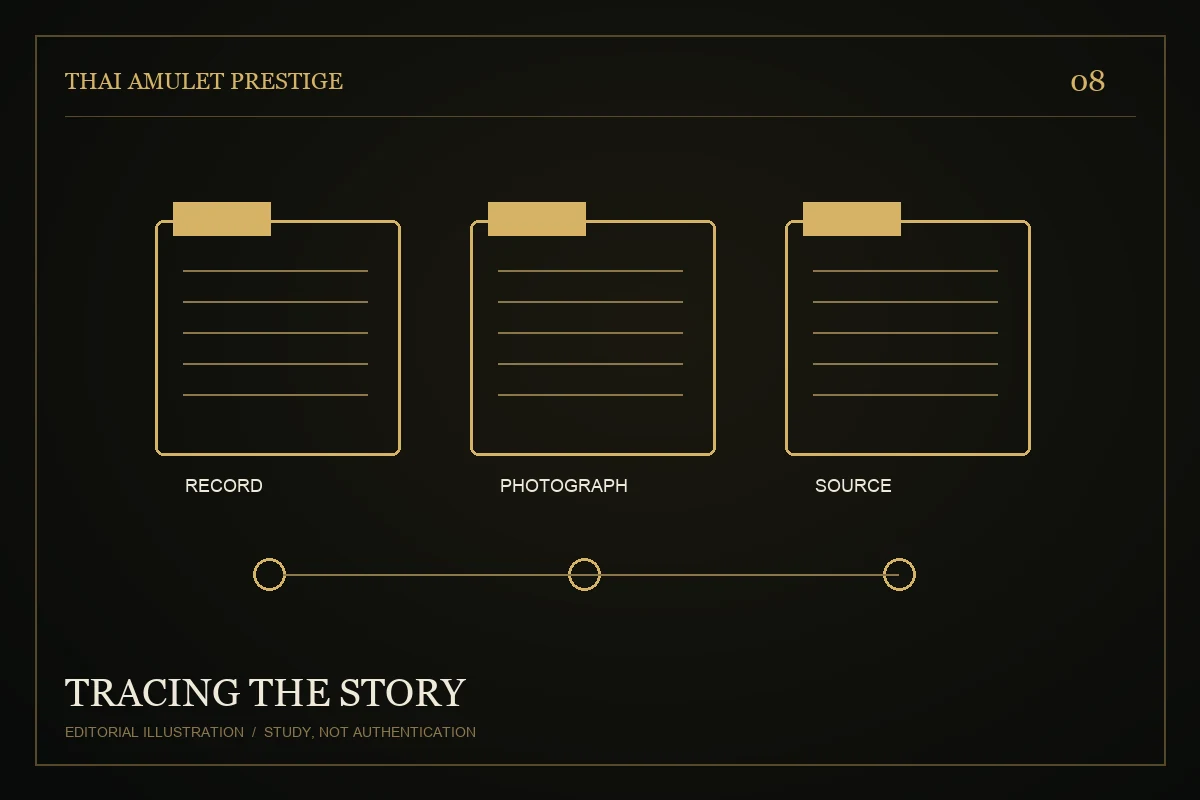
For a personal file, record the title, compiler, edition, publication year and relevant page numbers. If accounts conflict, retain both for comparison rather than discarding the less familiar version.
What should a biography help you understand?
A useful biography deepens understanding of a person and period while making the boundaries of current knowledge visible. It does not provide a formula for authenticating amulets through a single story. With this foundation, studying form, surface and ownership history becomes more focused.
Sources & further reading
- Somdet Phra Phutthachan (To Phrommarangsi) — Museum for the Support of BuddhismHis role as Wat Rakhang abbot in the reigns of Rama IV–V and the esteem in which he is held; not evidence of miracles or market value.
- Biography of Somdet Phra Phutthachan (To) — DhammathaiBirth in BE 2331, death in BE 2415 and variations in biographical accounts. The ordination year is not used because the source page contains inconsistent information.
- Catalogue: Biography of Somdet Phra Phutthachan (To) — Chulalongkorn University LibraryThe existence of a biography compiled and edited by Phra Khru Kanlayanukul. A route to further reading only, with no claim to have read the full book.
Translated and adapted from the Thai article compiled by Thai Amulet Prestige, using the listed sources and the editor’s study suggestions. This is not an authentication report for an individual amulet. The Thai source edition records its source check as 3 November 2026. Illustrations do not establish an amulet’s age, maker or authenticity.